


How Can You Tell the Age of a Tree? A Complete Guide
Introduction
The Mystery of Trees: How can you tell the age of a tree?
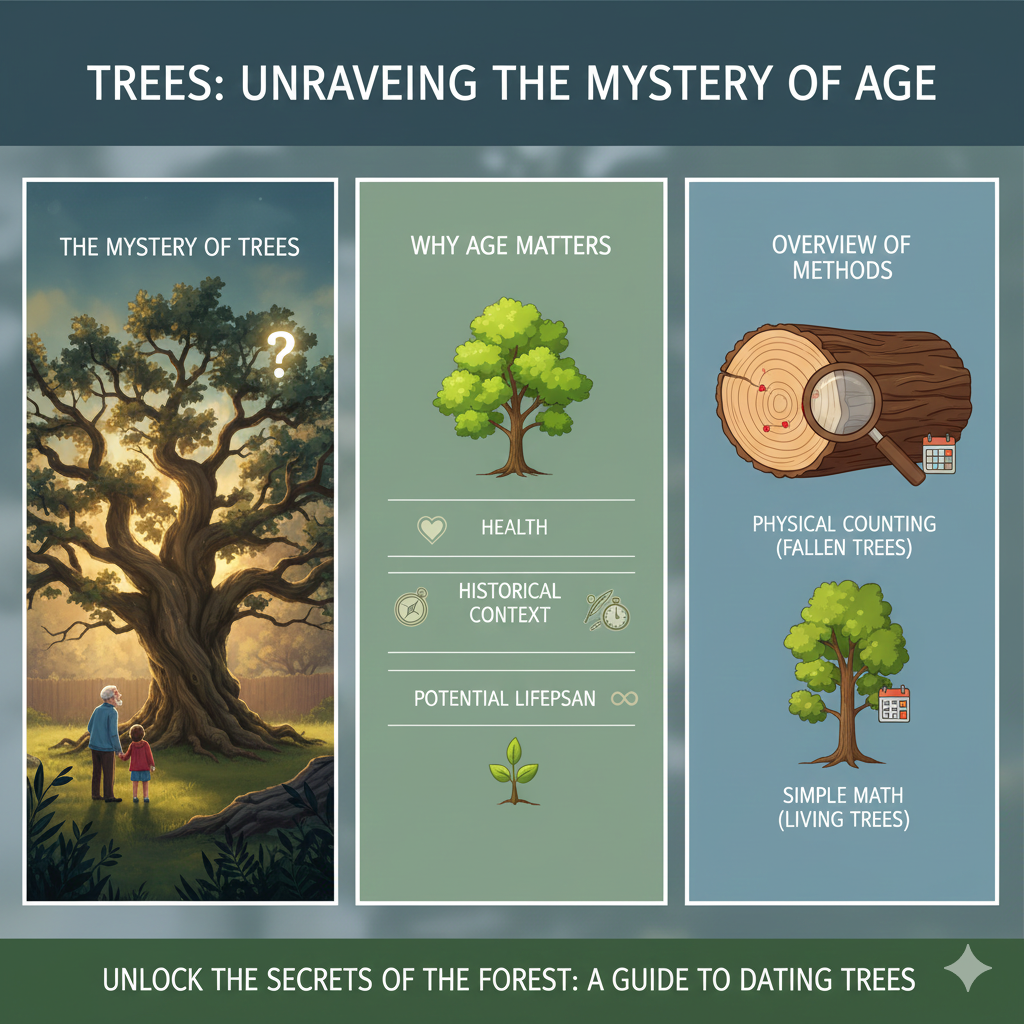
Many of us have stood in awe beneath the towering canopy of old trees in our backyards or local forests, wondering exactly how long they have stood watch over the landscape. Unlocking the age of a tree feels like uncovering a hidden piece of history. Whether it is a massive Red oak in the United States or a slender White birch, every tree species tells a unique story. People are fascinated by these giants because older trees represent resilience. They have survived decades of changing environments and dry seasons.
Table Of Content
- Introduction
- The Mystery of Trees: How can you tell the age of a tree?
- Why Tree’s Age Matters
- Overview of Methods: How to Age Trees
- Method 1: The Traditional Way (Counting Annual Rings)
- Dendrochronology Basics: What Are Tree Rings?
- Working with a Tree Stump
- Using an Increment Borer for Living Trees
- What Rings Tell Us: A Living History
- Method 2: The Living Tree Estimate (The “Growth Factor” Math)
- Step-by-Step Calculation
- Common Growth Factors Table
- Example Calculation: How can you tell the age of a tree?
- Method 3: The Whorl Method (For Conifers/Evergreens)
- Identifying Whorls
- The Calculation
- Factors That Affect Accuracy
- Environmental Impact on Growth Rate
- Tree Species Variation
- The Margin of Error
- Modern Tools & Technology
- Online Tree Age Calculators
- Mobile Apps and AI
- Advanced Scientific Methods
- Conclusion
- The Value of Mature Trees
- Call to Action: Discover the History in Your Backyard
Why Tree’s Age Matters
Knowing the age of the tree does more than satisfy curiosity. It is vital for assessing the health and historical context of our environment. By determining tree age, arborists understand the growth rate of a specific kind of tree. They can then predict its future lifespan.
For instance, knowing if a white oak is two hundred years old helps conservationists. They can better protect it from root stress or urban development. Furthermore, the age of trees provides a window into the past. It reveals how larger trees handled a wet year. It also shows how they survived long-term climatic shifts.
Overview of Methods: How to Age Trees
There are several ways to provide age estimates without needing a professional Phone Number or email address. The methods range from simple mathematical calculations for living trees to physical inspections of a tree stump.
- Physical Counting: For a tree that has been cut down, one can count the annual growth rings on the tree trunk.
- Scientific Sampling: Professionals often use an increment borer to extract a core sample. This tree core allows them to see the annual rings without harming the tree.
- Mathematical Estimation: For those looking at common trees in their yard, measuring the diameter of the tree and multiplying it by a specific X Growth Factor is a popular non-invasive method.
- Advanced Dating: In cases where rings are not visible, scientists may use carbon dating or radiocarbon dating to find the truth.
Method 1: The Traditional Way (Counting Annual Rings)
Dendrochronology Basics: What Are Tree Rings?
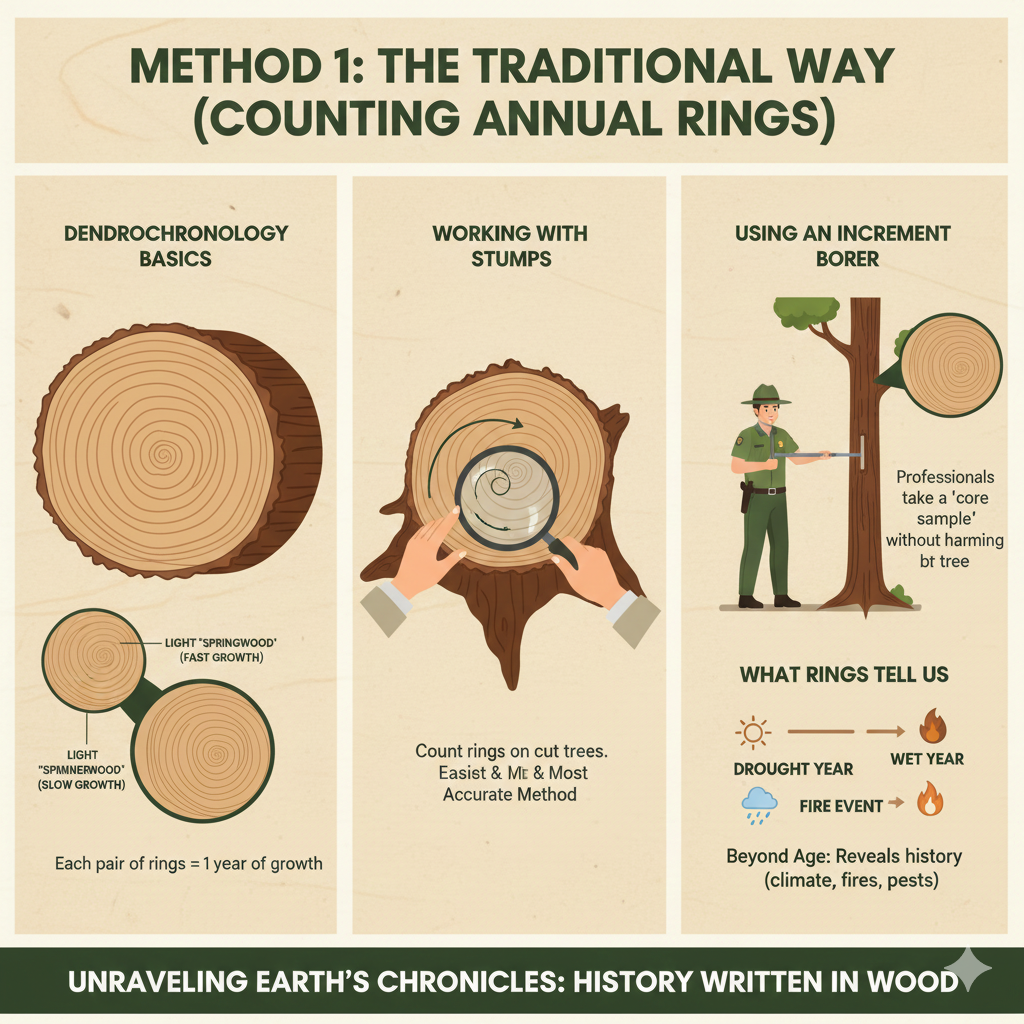
The study of a tree’s age through its growth cycles is known as dendrochronology. Inside the tree trunk, a tree typically adds a new layer of wood every year, resulting in what we call annual rings. These rings consist of two distinct parts: “springwood” and “summerwood”. Springwood is usually a lighter, wider section formed during the rapid growth of early spring, while summerwood is a darker, denser layer that grows as the season slows down. Together, these two shades represent one full year in the life of the tree.
Working with a Tree Stump
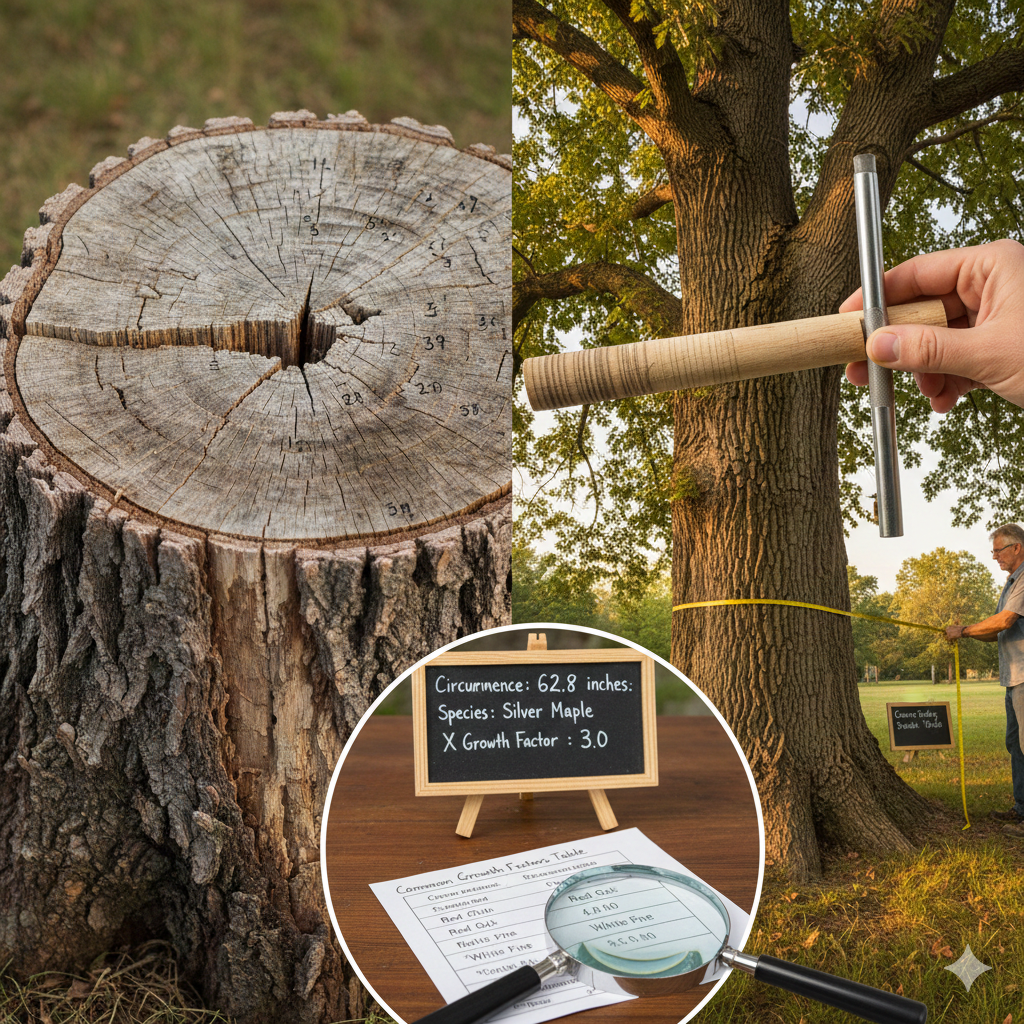
If a tree has already been cut down, the easiest way to determine the age of the tree is by inspecting the tree stump. To get an accurate count, start from the center (the pith) and count outward toward the bark. Sometimes, a wide ring can be seen. This indicates a year where the growth rate was exceptionally high due to perfect environmental conditions. For species like the Red maple, these rings can be quite distinct, making the counting process straightforward even for non-experts.
Using an Increment Borer for Living Trees
When dealing with living trees that we want to keep standing, professionals use a specialized tool called an increment borer. This tool allows an arborist to drill a tiny hole into the side of the tree to extract a thin tree core or core sample. This straw-sized sample shows the annual growth rings without significantly harming the tree. By examining this tree core, researchers can determine the tree age of a white oak or a Black Walnut while the tree continues to thrive in the forest.
What Rings Tell Us: A Living History
Tree rings offer a fascinating record of the past that goes far beyond just the age of a tree. The thickness and health of each ring reveal the environmental challenges the tree faced. For instance:
- Dry Seasons: Very narrow rings often point to years of drought or limited water.
- Wet Year: A wide ring suggests a year with plenty of rainfall and ideal temperatures.
- Forest Events: Scars within the rings can indicate past forest fires, while lopsided rings might suggest the tree was leaning or competing with larger trees for sunlight.
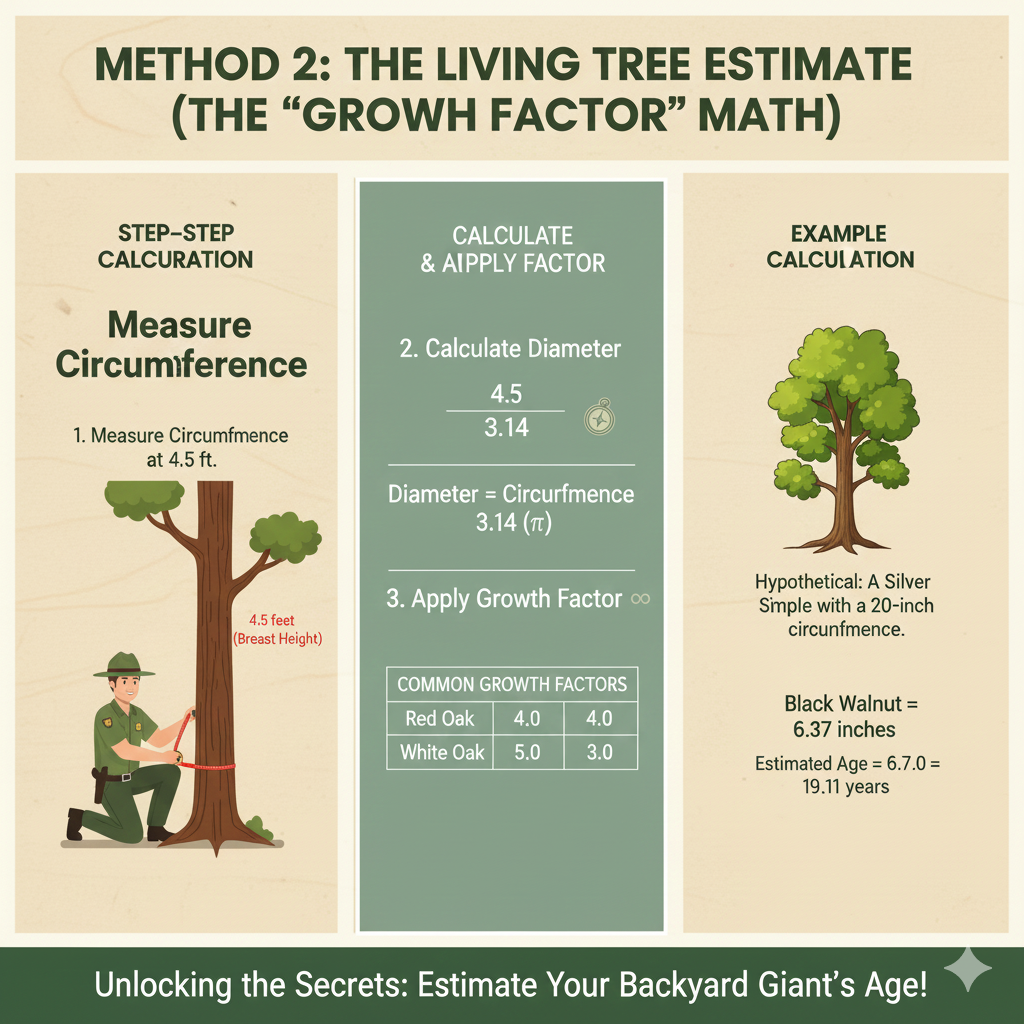
Method 2: The Living Tree Estimate (The “Growth Factor” Math)
If you are standing in front of healthy living trees and want to discover their history without specialized tools, you can use a mathematical approach to find the tree’s age. This technique is widely used by nature enthusiasts to determine the age of a tree without harming the tree trunk.
Step-by-Step Calculation
- Measure Circumference: Use a flexible measuring tape to find the distance around the tree. It is standard practice to measure at “Breast Height,” which is precisely 4.5 feet from the soil. This provides a consistent data point for any tree species.
- Calculate Diameter: Convert your circumference into diameter using this simple formula:
$$Diameter = Circumference \div 3.14$$ - Apply the Growth Factor: To finalize the estimate of the tree age, multiply the diameter you just calculated by the growth factor assigned to that specific tree.
Common Growth Factors Table
Arborists utilize a specific list of growth factors to account for the unique growth rate of different plants. Here are some factors for older trees and old trees often found in parks and forests:
| Tree Species | Growth Factor |
| white oak | 5.0 |
| Red oak | 4.0 |
| White Pine | 5.0 |
| Red maple | 4.5 |
Using these values is an effective way to Age Trees when you are unable to see tree rings or use laboratory methods like radiocarbon dating.
Example Calculation: How can you tell the age of a tree?
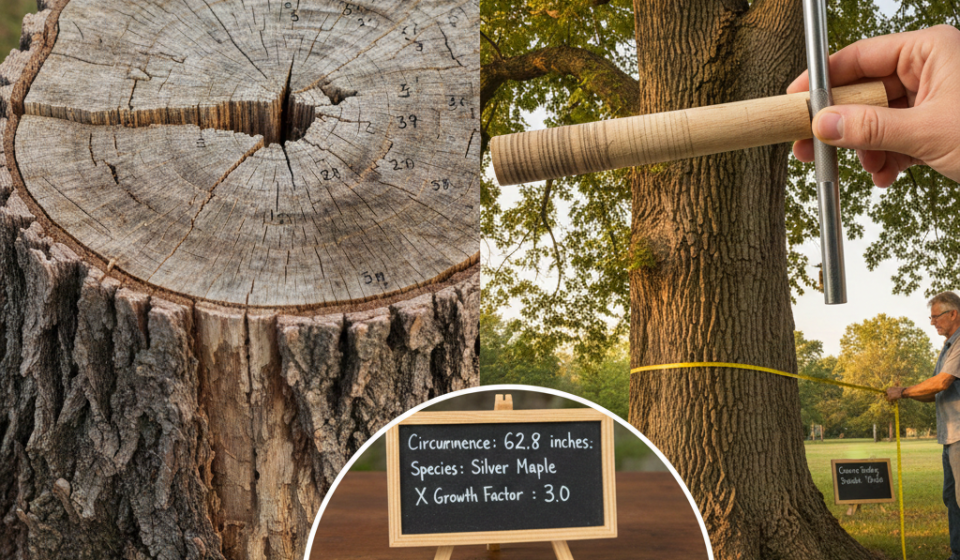
Let’s walk through an example of a Silver Maple. Suppose you find that its circumference is 62.8 inches.
- First, determine the diameter: $62.8 \div 3.14 = 20$ inches.
- Next, use the growth factor for a Silver Maple (which is typically 3.0).
- Multiply: $20 \times 3.0 = 60$ years.
By performing these calculations, you can successfully estimate the age of trees in your neighborhood, helping you appreciate the legacy of these silent giants.
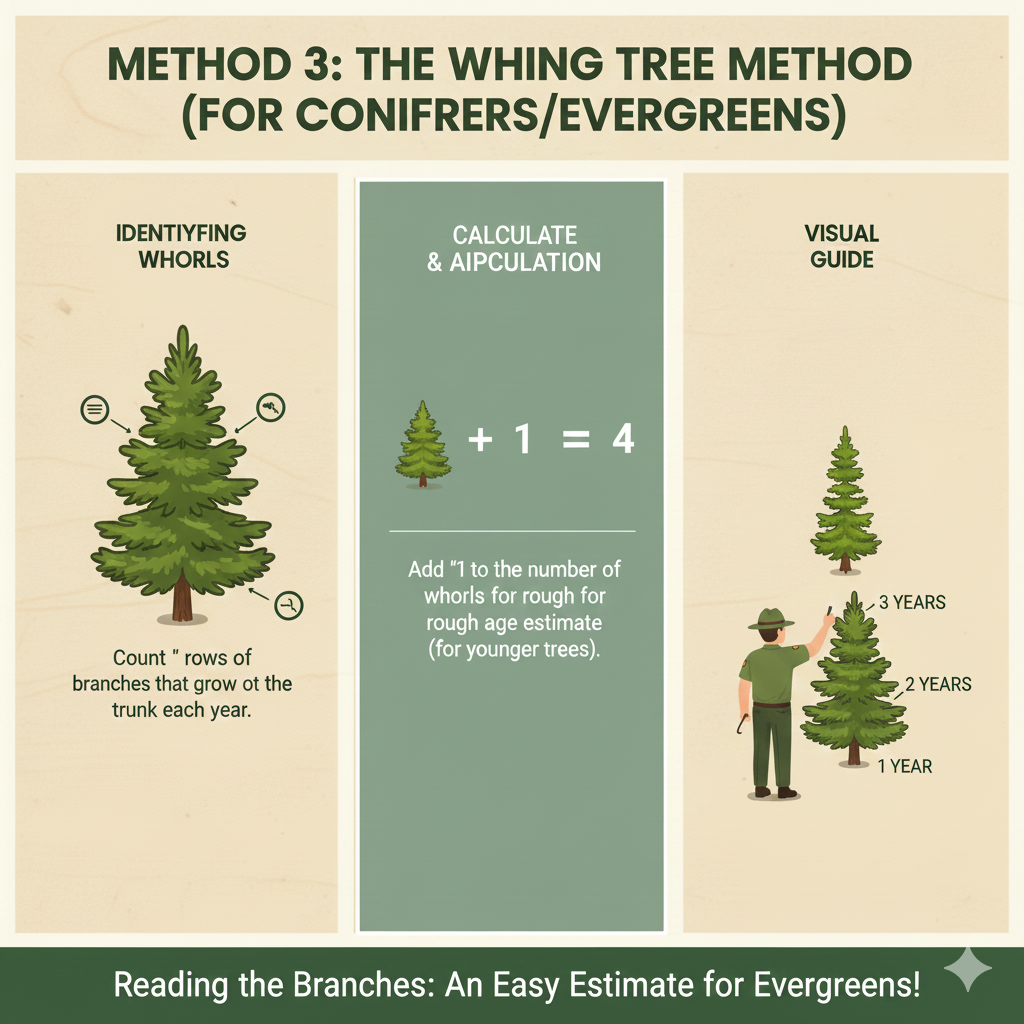
Method 3: The Whorl Method (For Conifers/Evergreens)
If you are looking at younger evergreens, such as a White Pine, you can use a visual technique called the whorl method to determine the tree’s age. This is a great way to Age Trees without needing a calculator or a core sample.
Identifying Whorls
A whorl is a circle of branches that grows out from the same level on the tree trunk. Most conifers produce exactly one whorl of branches each year. To use this method:
- Locate the “rows” of branches starting from the bottom of the tree.
- Count each level of branches as you move up toward the top.
- Be sure to look for small scars on the bark where branches may have fallen off in previous years, as these still count as a whorl.
The Calculation
To get the most accurate age of the tree, simply count the number of whorls and add one. This extra year accounts for the time it took for the seedling to grow its very first set of branches. While this is one of the easiest age estimates to perform, it works best on younger, common trees. As a tree becomes one of the older trees in the forest, the lower branches often fall off and the bark thickens, making it much harder to see the whorl patterns clearly.
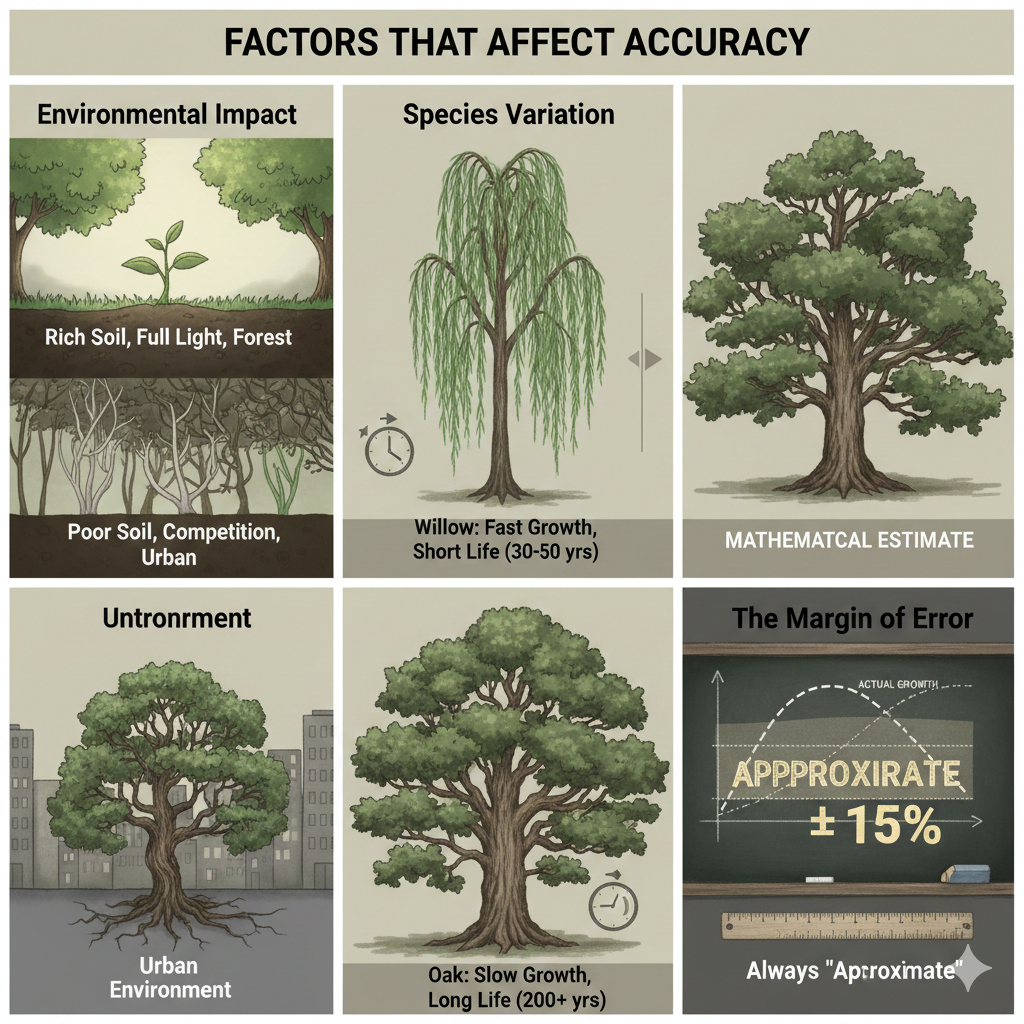
Factors That Affect Accuracy
While the methods above are reliable, determining the age of trees is rarely an exact science due to several external variables that influence how a tree develops over time.
Environmental Impact on Growth Rate
The environment plays a massive role in how a tree trunk expands.
- Soil Quality: Trees growing in nutrient-rich, well-drained soil will typically have a faster growth rate than those in poor or compacted earth.
- Competition for Light: In a dense forest, larger trees often shade out smaller ones, slowing their development, whereas a tree in an open field may grow much faster.
- Urban vs. Forest: Trees in cities often face root stress from pavement and pollution, which can lead to irregular annual growth rings compared to their forest-dwelling counterparts.
Tree Species Variation
Different types of trees have vastly different biological blueprints.
- Fast-Growing Species: Trees like Willows or the White birch tend to grow rapidly but have shorter lifespans.
- Slow and Steady: species like the white oak or Black Walnut grow much more slowly. However, they can stand as old trees for centuries. Because of these variations, you cannot use a single X Growth Factor for every kind of tree. Doing so would result in highly inaccurate age estimates.
The Margin of Error
It is important to remember that unless you are counting annual rings on a tree stump or using radiocarbon dating, most results are “approximate”. Even a core sample taken with an increment borer might miss the exact center of the tree, leading to a slight undercount. Mathematical formulas provide a wonderful window into the age of the tree, but they cannot account for every wet year or period of drought the tree has survived.
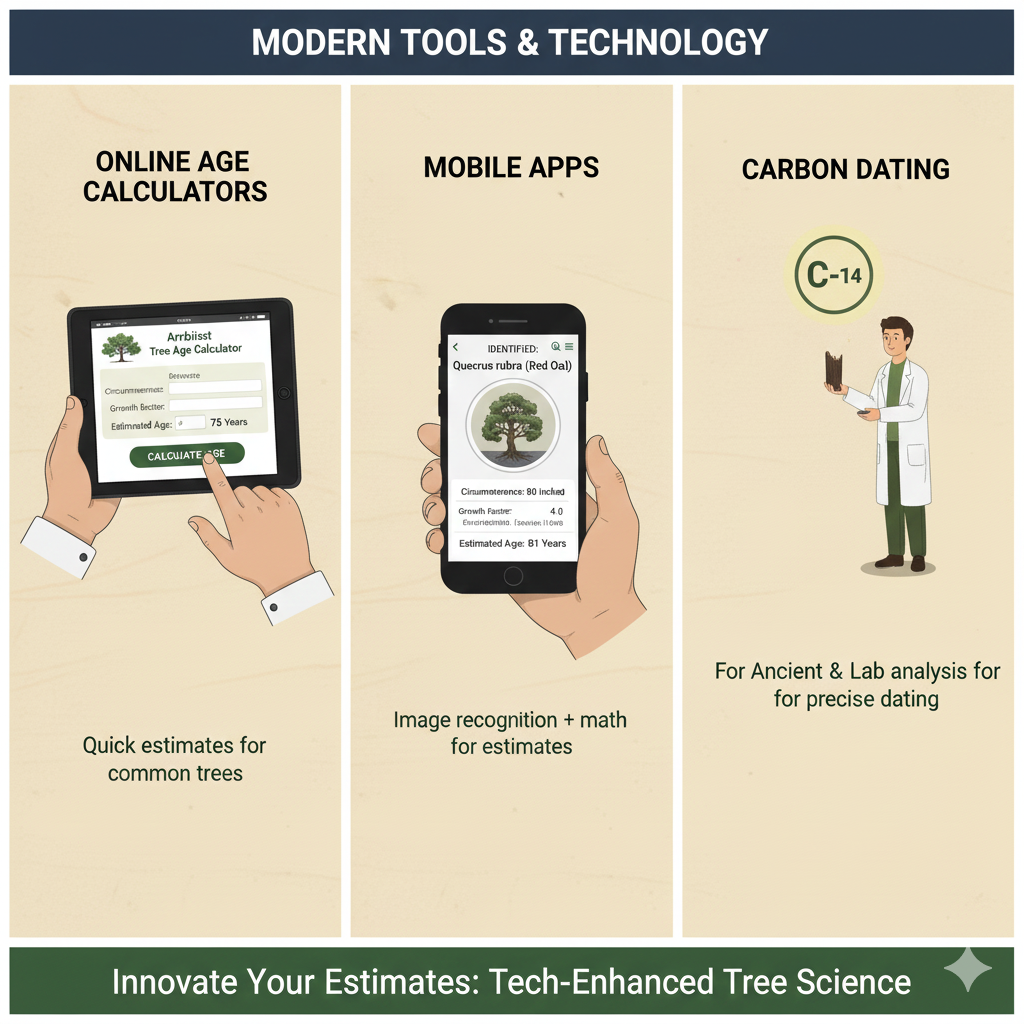
Modern Tools & Technology
While historical methods like counting annual rings remain foundational, modern technology has made determining the age of a tree much faster and more accessible to everyone.
Online Tree Age Calculators
For a quick estimate, many enthusiasts use digital tools like the Arborist Halifax Tree Age Calculator. These Age Trees by allowing you to enter the diameter of the tree and select the specific tree species. The calculator then automatically applies the correct X Growth Factor to provide an instant estimate of the tree’s age. It is a perfect solution for those who want a baseline understanding of the common trees on their property without doing the math by hand.
Mobile Apps and AI
Identifying the kind of tree you are looking at is the first step toward finding its age. Mobile apps like iNaturalist use advanced image recognition to help users identify tree species from a simple photo. Once the species is confirmed, you can look up its specific growth rate or use the data in a calculator. These apps are particularly helpful for distinguishing between similar-looking older trees, such as a Red oak versus a white oak, which may have different aging factors.
Advanced Scientific Methods
In professional or academic settings, scientists sometimes move beyond a simple core sample or increment borer.
- Radiocarbon Dating: For ancient trees or tropical species that do not produce traditional annual growth rings, researchers use carbon dating. By measuring the decay of carbon-14 isotopes in the wood, they can determine the age of trees that have stood for thousands of years.
- Lignostation Systems: High-resolution scanning systems can analyze a tree core with extreme precision, revealing tiny details about the age of the tree that the human eye might miss.
Conclusion
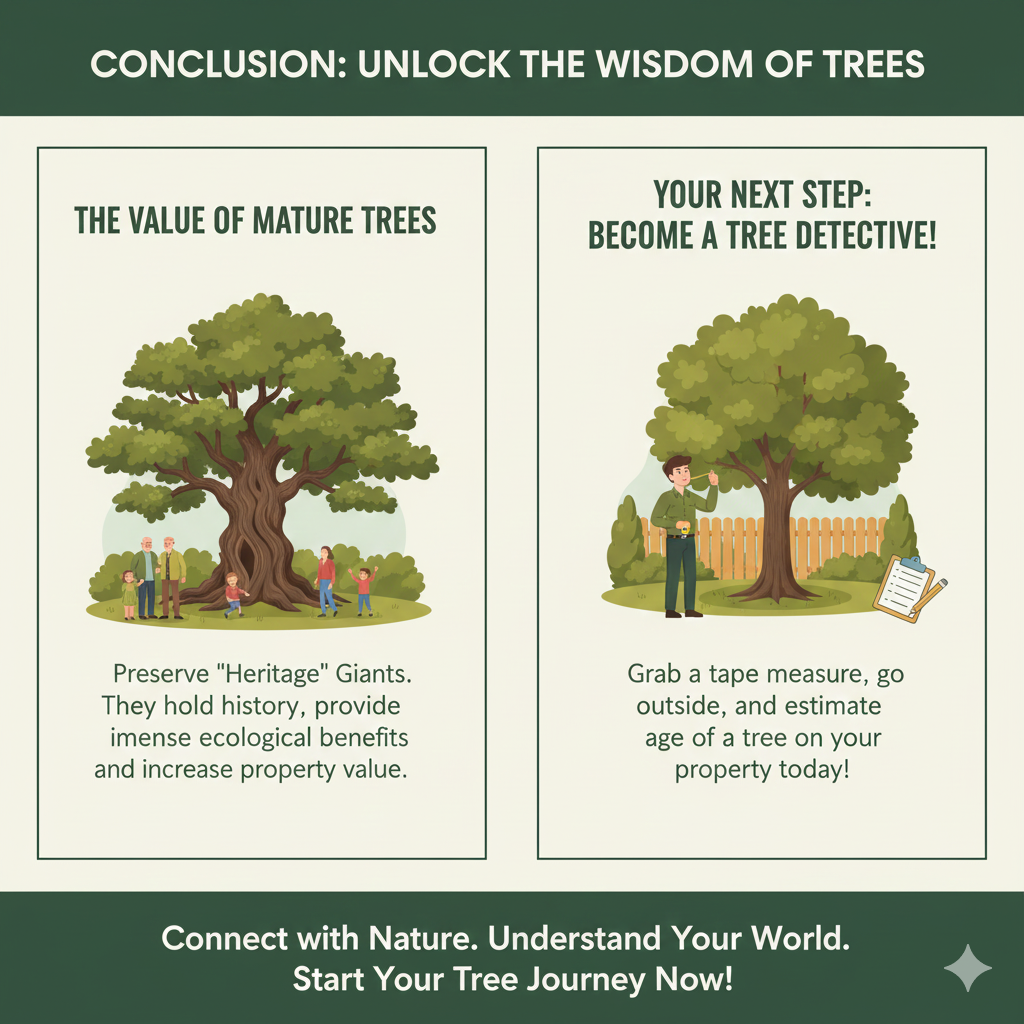
The Value of Mature Trees
Preserving “heritage” trees is a vital responsibility for our environment and future generations. Old trees, like a majestic white oak or a towering White Pine, serve as living monuments that have witnessed centuries of change. These larger trees provide more than just shade; they are complex ecosystems that support local wildlife and help mitigate the effects of climate change. Whether you are looking at the annual rings on a tree stump or estimating the tree age of living trees in a park, understanding a tree’s age fosters a deeper respect for these natural wonders.
Call to Action: Discover the History in Your Backyard
Now that you know how can you tell the age of a tree, why not try it for yourself? You don’t need a professional increment borer or a lab for radiocarbon dating to get started. Simply grab a measuring tape, head outside, and find a tree trunk to measure. Whether it is a Red maple or a Black Walnut, calculating the age of the tree is a rewarding way to connect with nature. If you have questions or want to share your findings, feel free to reach out via our email address or check out a local list of growth factors to refine your age estimates. Go out today and uncover the hidden history standing right outside your door!